



Brazil’s fertilizer market is facing its most complex conditions in at least 25 years, threatening to push up food prices and strain supplies, according to Eduardo Monteiro, country manager of The Mosaic Company in Brazil.
“This is the most complex environment for our segment in 25 years,” Monteiro said in an interview with The AgriBiz, citing a combination of high input costs, weak farm profitability, tight credit and elevated interest rates. The impact is likely to ripple across the supply chain, lifting food prices and raising concerns about food security, he said.
Comparisons with 2022, when the Russia-Ukraine War drove a surge in fertilizer prices, are unavoidable. In Brazil, the current environment is even more complex, Monteiro said.
Brazilian farmers were well-capitalized at the time, supported by strong grain prices. Now, many are heavily indebted, with little prospect of a price rally and limited access to financing. The situation has been compounded by the war in Iran, which has tightened global fertilizer supply.
“Back in 2022, logistics flows were never disrupted. Now they are,” Monteiro said.
The disruption is centered in the Strait of Hormuz, a key Middle East shipping route that handles roughly one-third of global flows of fertilizer inputs such as sulfur and urea.
Prices have reacted swiftly. Fertilizer costs have jumped as much as 35% since the conflict began, according to Monteiro.
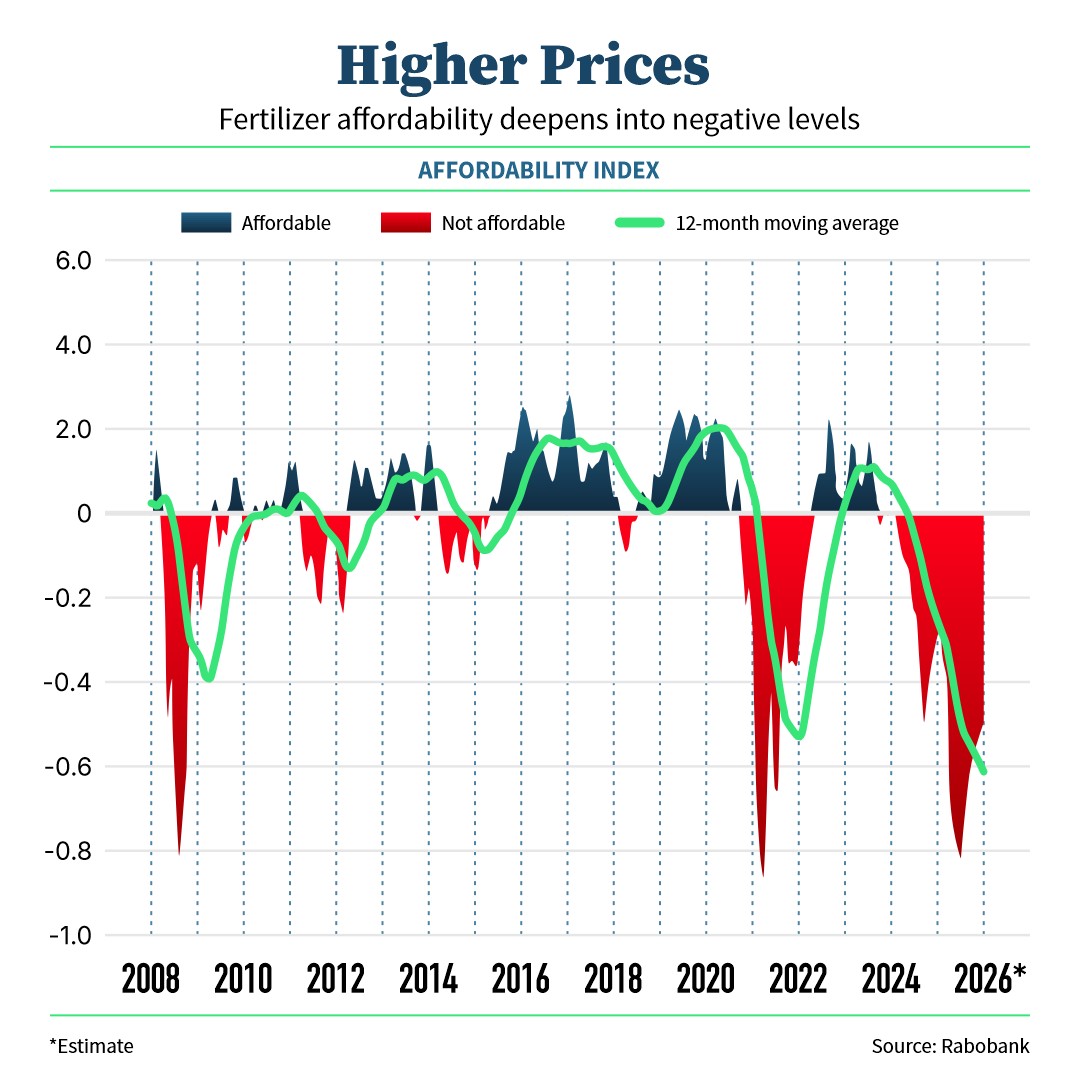
At the same time, farm-gate soybean prices have remained broadly flat in the South American nation, as the strengthening Brazilian real offset a modest recovery in dollar-denominated futures on the Chicago Board of Trade. The result is one of the worst fertilizer affordability ratios on record.
Mosaic estimates that it currently takes 32 to 33 bags of soybeans to purchase one metric ton of fertilizer, compared with an average of 25 bags last year and 24 bags in 2022 (a bag weigh 60 kilograms). A more favorable level for farmers is around 21 bags per ton.
“The affordability ratio is much worse than in previous years, especially for phosphorus,” Monteiro said. “Farmers will look for alternatives to reduce application rates.”
That raises the risk that growers cut nutrient use to levels that hurt yields, potentially triggering a supply shock. “That could impact food costs and prices,” he said.
High prices are already slowing demand. Between 45% and 50% of fertilizer purchases for Brazil’s 2026/27 soybean crop remain open, according to Jeferson Souza, a market intelligence analyst at Agrinvest.
Across the broader market, Mosaic estimates fertilizer sales are running 15 to 20 percent below the same period last year.
“We still don’t know how large this market will be in 2026,” Monteiro said. Brazil’s fertilizer deliveries reached a record of about 49 million tons in 2025, a level expected to decline this year, though the size of the drop remains uncertain.
As farmers delay purchases, fertilizer producers are warning that shipping constraints could lead to delivery delays, urging growers to secure supplies sooner.
“The disruption in logistics flows is materially significant,” Monteiro said, adding that global inventories are falling and not being fully replenished.
Sulfur Surge
A sharp increase in sulfur prices — a key input for phosphate fertilizers — has already forced strategic shifts. Mosaic recently announced the sale of its operations on its Araxá complex, in Minas Gerais, where it relied on imported sulfur to produce phosphates.
Since the start of the conflict involving Iran, sulfur prices have climbed more than 50%, worsening a market already under strain since 2022, when supply was hit by disruptions linked to Russia, a major exporter.
“Sulfur used to cost about $100 and is now trading above $1,000 per ton,” Monteiro said.
Beyond geopolitical tensions, rising demand from the metals industry — particularly for electric-vehicle batteries — has further tightened supply.
Against this backdrop, Mosaic is expanding its focus on biological solutions to help farmers offset potential reductions in fertilizer use. Organomineral products, which partially replace conventional inputs, are also expected to gain traction.
Bio-inputs are central to the company’s strategy in Brazil. This week, at Agrishow, the country’s largest farming fair, Mosaic launched a new mineral fertilizer, BioBlend, aimed at boosting yields across crops including soybeans, corn and sugar cane.


