

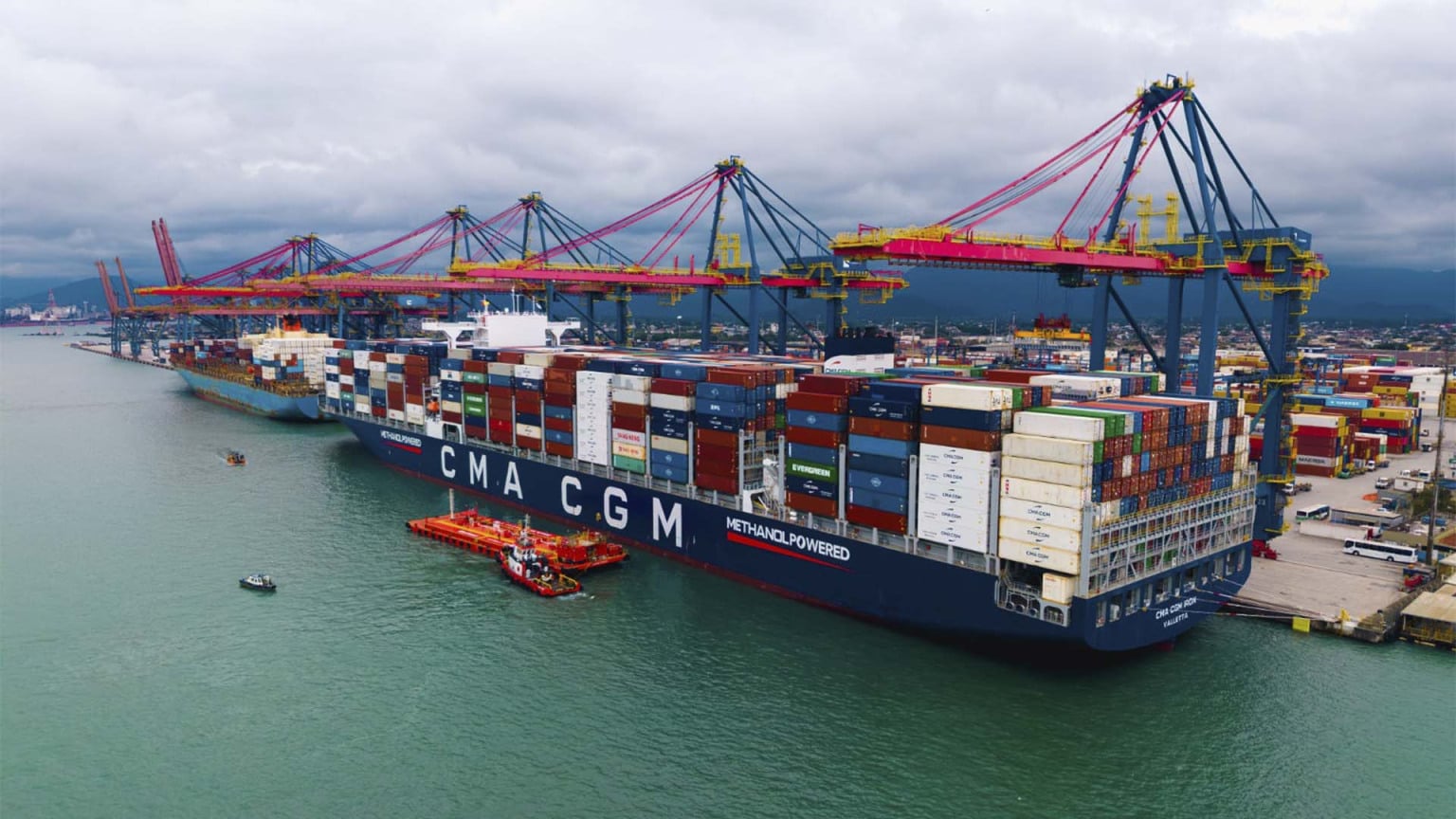

SANTOS, Brazil — A transoceanic container ship fueled with Brazilian ethanol is set to leave the Port of Santos for Sri Lanka on Tuesday, marking a potentially significant step in efforts to decarbonize maritime transport and create a new source of demand for Brazil’s sugar-and-bioenergy industry.
The CMA CGM Iron was loaded with 500 metric tons, or 635,000 liters, of ethanol supplied by Copersucar. Initial estimates indicate the biofuel could reduce greenhouse-gas emissions by 67% to 70% compared with conventional marine fuel.
The trial follows two years of testing and engine development. The vessel, which can carry 13,000 containers on routes connecting Asia, Europe and the Americas, was fueled on Sunday.
French shipping and logistics group CMA CGM adapted the ship’s engine to run on three fuels: conventional fossil fuel, methane and ethanol. AGEO Terminais, Santos Brasil and Bunker One also participated in the operation.
The companies have not said whether ethanol will power the entire voyage or be used only during selected portions of the route.
For Copersucar, one of the world’s largest sugar and ethanol traders, maritime transport could become a transformative market if Brazilian ethanol gains recognition under international shipping regulations.
Replacing just 10% of the shipping industry’s fuel consumption with ethanol would generate potential demand of 50 billion liters, Copersucar Chief Executive Officer Tomás Manzano said. Brazil currently produces about 37 billion liters annually.
“That would mean investment for Brazil and opportunities for companies capable of building the supply chain,” Manzano said.
The test also positions Brazil and the Port of Santos in the competition to develop the logistics and safety systems needed to refuel ships with biofuels, said Neusa Ferreira Marcelino, CMA CGM’s CEO in Brazil.
The CMA CGM Iron is the first of 12 container ships expected to receive the tri-fuel engine. The French company aims to operate about 200 vessels using what it calls low-carbon energy sources by 2031.
Scale Remains Distant
Despite the potential, the companies do not yet have a clear timetable for large-scale commercial adoption.
Regulatory standards governing ethanol production and transportation need to be updated, while international certifications will be required for exports and maritime use.
Brazilian biofuels also face resistance in some markets, particularly the European Union, over concerns that producing fuel crops may compete with food production. Some industry analysts regard that argument as a protectionist trade barrier framed as a food-security concern.
Infrastructure presents another obstacle. Ports and fuel suppliers would need to expand storage and distribution capacity and establish green shipping corridors where ethanol-powered vessels could refuel reliably, Manzano said.
Energy efficiency and cost remain the biggest challenges. At current technology levels, a ship requires the energy equivalent of between 1.6 and 1.7 metric tons of ethanol to replace one metric ton of conventional marine fuel.
Ethanol is also more expensive than fossil-based shipping fuel, a disadvantage in the highly competitive container-shipping industry.
Still, Copersucar argues that ethanol has a stronger economic case than other maritime decarbonization alternatives, including methanol, ammonia, hydrogen and natural gas.
Manzano said expanding production would not necessarily require clearing new land because sugarcane cultivation in Brazil has grown mainly on degraded pasture. He also cited RenovaBio, Brazil’s national biofuels policy, as a mechanism designed to encourage lower-carbon production and discourage deforestation.
Carbon credits could eventually help offset ethanol’s higher price and lower energy density once mandatory and voluntary carbon markets are more fully regulated, he said.
“Ethanol has the most competitive economics among the decarbonization alternatives,” Manzano said. “It is still more expensive than fossil marine fuel, but greater scale should reduce that gap. Carbon credits, currently valued at between $100 and $150, could also help balance the equation as regulation advances.”
The reporter traveled to Santos at Copersucar’s invitation. This story was translated with the assistance of artificial intelligence and reviewed by The AgriBiz editorial staff.


