

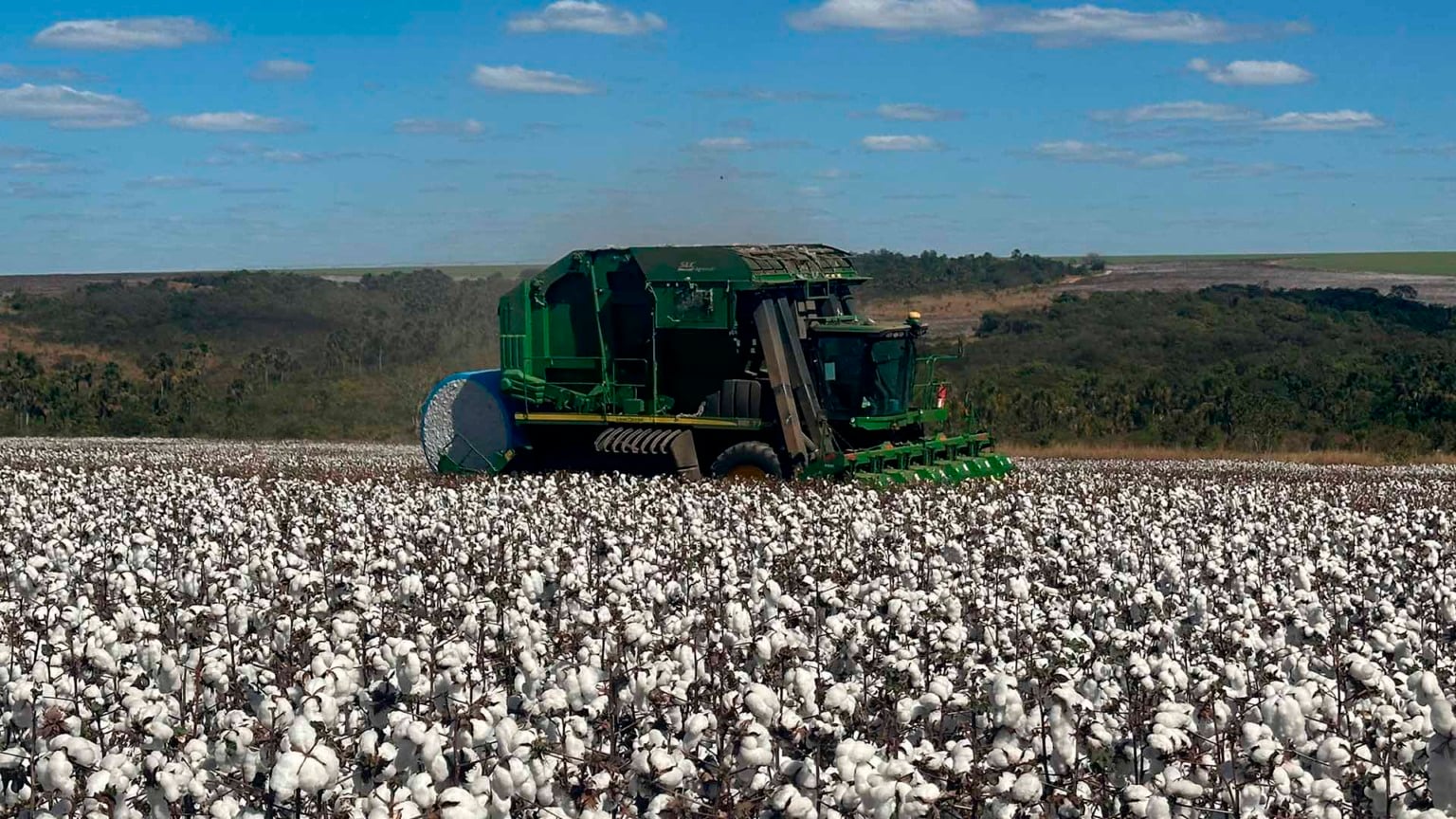

Brazil, the world’s largest cotton exporter, is expected to reduce cotton planted area by 4% in the 2025/26 season after weak prices discouraged growers from expanding the crop, according to initial estimates released by consultancy Agroconsult on Thursday.
Planted area is seen at 2.12 million hectares (5.24 million acres). Higher yields are expected to partly offset the decline, leaving production at 4.2 million metric tons, down 1.5% from the previous season.
Agroconsult will begin its annual crop tour on Monday to validate the forecasts in the field.
The acreage decline was most pronounced in Mato Grosso, Brazil’s largest cotton-producing state, where planted area is projected to drop 6.5% to 1.4 million hectares (3.46 million acres).
“The spot market was the main driver of planting decisions,” Heloisa Melo, managing partner at Agroconsult and technical coordinator for the cotton leg of the Rally da Safra crop tour, said.
Cotton futures traded below 70 U.S. cents per pound in New York for much of last year and fell to around 65 cents in the second half, reducing growers’ expected returns, Melo said.
At the same time, the traditional premium received by Brazilian producers over New York prices reversed as Brazil’s crop entered the market. Instead of selling at a premium of about 5 cents per pound, growers were receiving roughly a 5-cent discount.
Brazil’s larger exportable supply also reduced appetite for cotton-linked contracts and weighed on market liquidity during the planting season. Corn, meanwhile, offered better returns as rising demand from Brazil’s corn ethanol industry supported prices.
“There’s a limit to how much cotton area can fall because growers have already made significant capital investments in gins and specialized equipment,” Melo said. “Our field visits will confirm whether the reduction was indeed around this level.”
Agroconsult currently projects Mato Grosso’s cotton production at 2.9 million metric tons, down 5.6% from the previous season. Average yields are estimated at 318 arrobas, up from 315 arrobas a year earlier (one arroba weighs 15 kilograms).
“There are expectations of strong yields across the state, with the exception of the eastern region, where rainfall was irregular during crop development,” Melo said.
Irrigation Supports Bahia Crop
In Bahia, planted area is expected to remain stable at 425,000 hectares (1.05 million acres), supported by continued expansion of irrigation.
Irrigated fields now account for nearly half of the state’s cotton area, allowing farmers to plant later than usual in the 2025/26 season, Melo said.
Production in Bahia is projected to rise 10.6% to 882,000 metric tons, with yields estimated at 335 arrobas, according to Agroconsult. Bahia has averaged about 320 arrobas in recent seasons, even after a decline to 305 arrobas last year mainly because of irregular rainfall.
“So far, the first harvested fields are showing excellent yield potential,” Melo said.
This story was translated from the original Portuguese with the assistance of artificial intelligence and reviewed by The AgriBiz editorial staff.


