

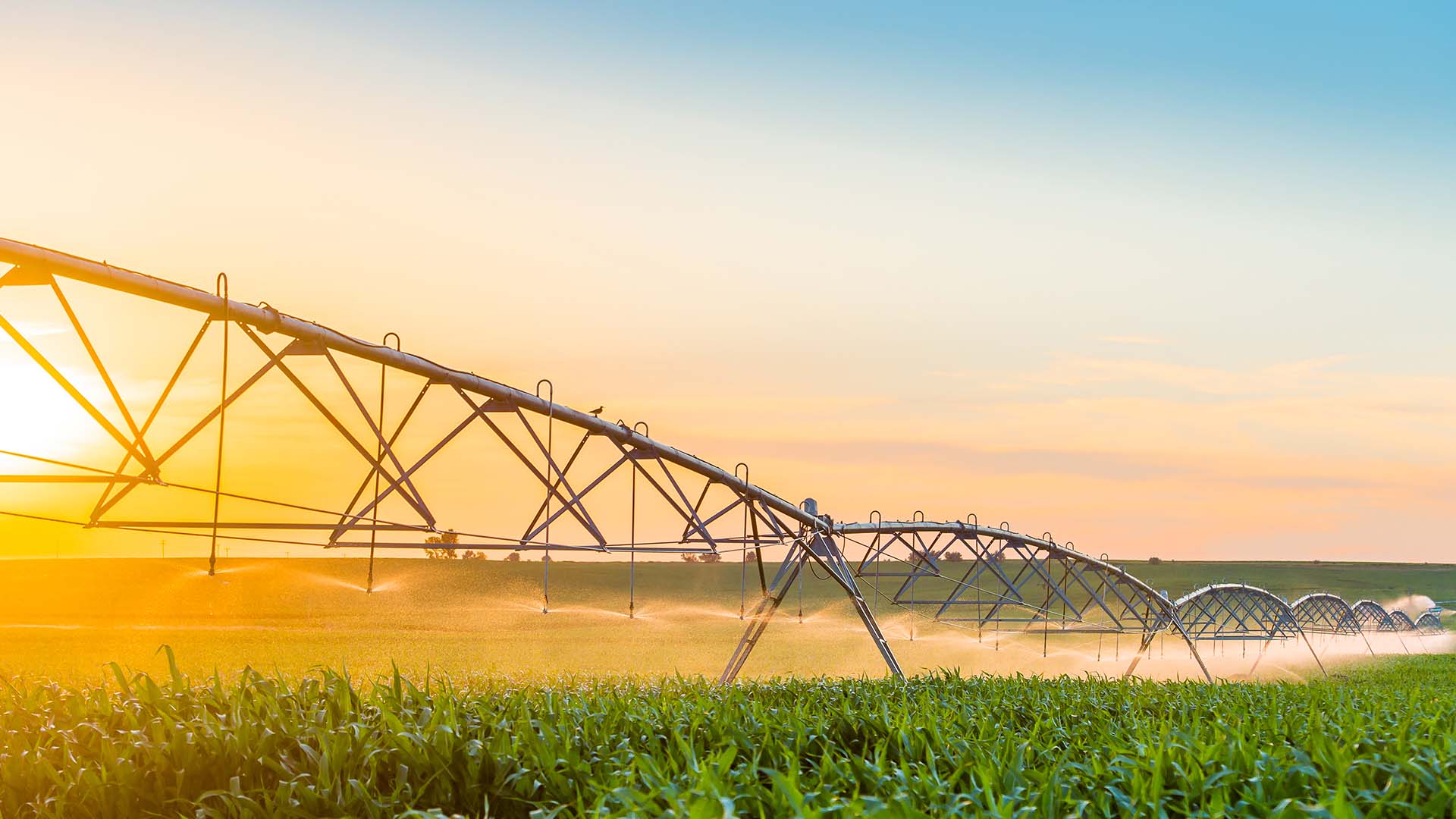

Irrigation has transformed agriculture in western Bahia, driving sharp yield gains in soybean and cotton production. For researchers and industry executives, the recent advances are only a glimpse of the state’s long-term potential.
In the 2025/26 season, Bahia posted Brazil’s highest soybean yields at 70.3 60-kg bags per hectare, compared with the national average of 62.7 bags per hectare, according to consultancy Agroconsult. For the next season, the firm also expects stronger cotton performance, projecting yields of 335 arrobas per hectare (about 5 metric tons of lint per hectare), versus a national average of 320 arrobas.
The region’s production system typically combines soybeans as the first crop with irrigated cotton as the second crop. Even when soybeans are grown without irrigation, they benefit from improved soil conditions created by the irrigated production system.
Agroconsult estimates that irrigation is already used on nearly half of Bahia’s 425,000 hectares (1.05 million acres) of cotton fields.
Most of those farms are concentrated in western Bahia, the country’s largest irrigated agricultural production hub. According to Aiba, the Association of Farmers and Irrigators of Bahia, the state has roughly 375,000 hectares (926,000 acres) under irrigation across all crops.
50,000 Hectares a Year
Investment in irrigation has accelerated over the past five years. Since 2021, irrigated acreage has expanded by about 50,000 hectares (124,000 acres) annually, up from an average of 10,000 hectares in previous years, said Everardo Mantovani, senior professor at the Federal University of Viçosa and an irrigation consultant.
The expansion gained momentum after farmer Julio Busato, then president of Aiba, asked the university in 2016 to assess the region’s irrigation potential.
The study, conducted between 2019 and 2021, found that the Urucuia Aquifer — the region’s main groundwater source — receives an average recharge of 600 cubic meters of water per second. At the time of the study, irrigation withdrawals totaled about 40 cubic meters per second.
“We proposed using 20% of the water that recharges the aquifers for irrigation. That amounts to 120 cubic meters per second. Since only 40 cubic meters per second was being used, we concluded there was room to expand irrigated acreage sustainably,” Mantovani said.
Multinationals Move In
The region’s potential has become a business opportunity. Lindsay, one of the world’s largest irrigation equipment manufacturers, has expanded steadily in western Bahia since the pandemic and continues investing to strengthen its presence closer to local distributors and farmers.
“Today, second- and third-generation family members are taking over these farms. They are well educated and know how to manage the soil, which means irrigation companies also need to be much better prepared,” said Claudio Lima, Lindsay’s vice president of irrigation for Latin America.
Beyond expanding its commercial operations, Lindsay has been adapting its equipment to Brazilian farming conditions. According to Lima, a center-pivot irrigation system in the United States typically has seven spans and a radius of about 300 meters. In Bahia, systems usually have between 18 and 19 spans.
“Equipment utilization is much higher than in the United States. There, a pivot is generally used for a single crop. Here, it is used for three,” Lima said.
The technology accompanying irrigation systems has also advanced. “In sprinkler irrigation systems from the 1950s, water losses reached 40%. Modern center pivots have reduced losses to around 10%, while delivering much higher energy efficiency,” said Laércio Miranda, director of irrigation company Irrigaplan.
Lindsay, for example, sells a software called FieldNET Advisor, which can connect to soil sensors to recommend how much water to apply and when, helping farmers maximize yields.
“That is especially important in Bahia because it is a region with a very high level of technical expertise. Some producers there have been irrigating since 1985,” Lima said.
Challenges
Further expansion of irrigation will depend on overcoming infrastructure bottlenecks, particularly electricity supply.
“We have an 800-hectare (1,977-acre) irrigation project. The wells are ready, but now we’re waiting for the power connection, which is expected next year,” said José Ranulfo Queiroz, a farmer in western Bahia and owner of Estreito Agropecuária.
At this year’s Bahia Farm Show, a local farm fair, authorities announced investments to expand and modernize the state’s electricity transmission network. Local utility Neoenergia Coelba plans to invest about $4.85 billion (25 billion reais) in transmission infrastructure and new substations through 2030.
“That will be extremely important,” Lima said. “Today, only 2% of Mato Grosso’s farmland is irrigated because of a lack of power distribution lines. Sorriso, the world’s largest soybean-producing municipality, faces electricity shortages at night. The same happens in Luís Eduardo Magalhães, in Bahia.”
This story was translated from the original Portuguese with the assistance of artificial intelligence and reviewed by The AgriBiz editorial staff.


