



Indonesia is pouring billions of dollars into expanding its animal protein supply, turning to foreign investors and its sovereign wealth fund to address nutritional gaps in the world’s fourth-most populous country.
The strategy is creating opportunities for global food companies, including Brazil’s JBS, which struck a partnership with Indonesia’s sovereign wealth fund in August involving investments of $2.5 billion.
Under the agreement, the Indonesian fund will acquire stakes of as much as 30% in JBS’s assets across Southeast Asia and Oceania, in a transaction valuing the Brazilian meatpacker’s regional business at up to $10 billion. JBS has committed to prioritizing investments in Indonesia during the partnership’s initial years.
The deal is part of a broader government effort to diversify food production in a country whose agricultural economy has long been dominated by palm oil.
Indonesia is the world’s largest palm oil producer, with plantations covering 16 million hectares (39.5 million acres), or roughly 30% of its agricultural land. The industry also supports the country’s aggressive biodiesel blending policy.
Indonesia also says it has achieved self-sufficiency in rice, a staple for its population of more than 280 million. Yet nearly one in five children under five suffers from stunted growth linked to chronic malnutrition, highlighting persistent gaps in nutritional quality despite the availability of staple foods.
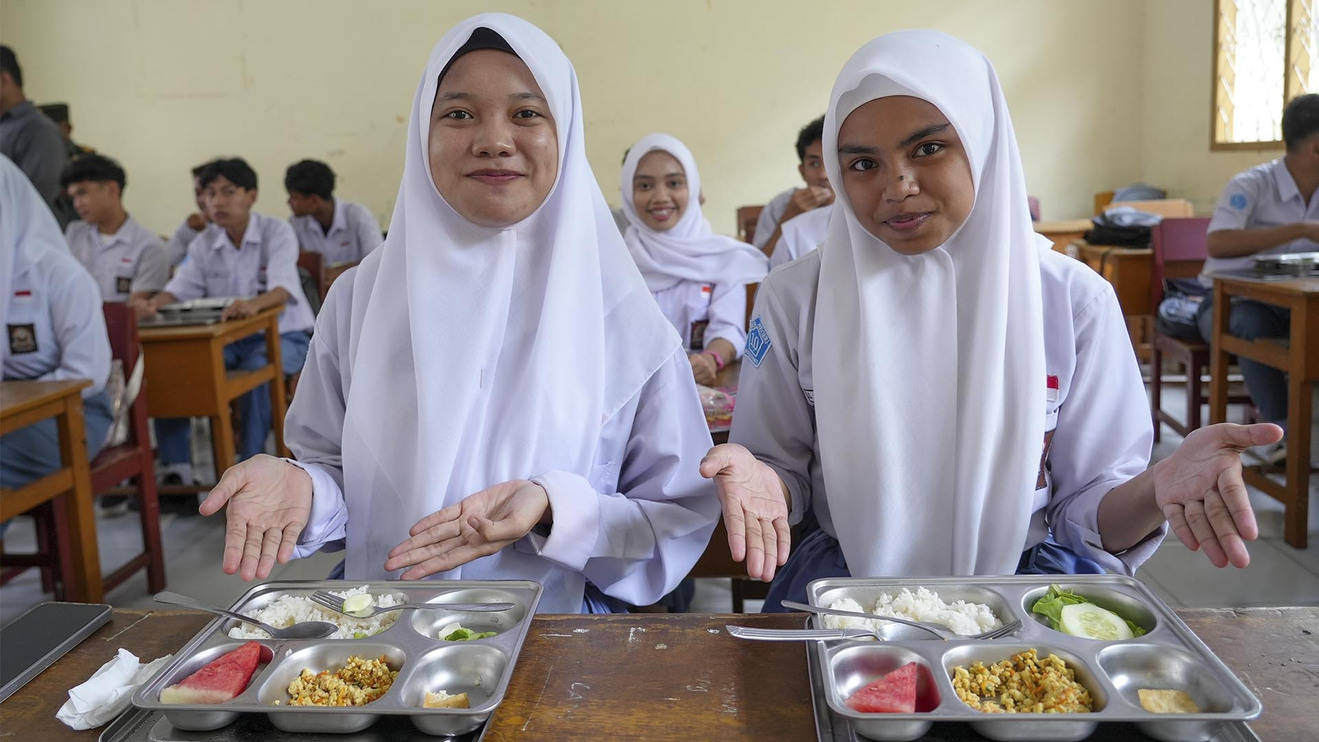
President Prabowo Subianto launched a nationwide free nutritious meals program, known as Makan Bergizi Gratis, in 2025. The initiative provides chicken, eggs, vegetables, rice and plant-based protein to children, students, pregnant women and nursing mothers.
The program already serves nearly 60 million people and aims to reach 72 million by 2027.
Indonesia is also seeking foreign capital to expand domestic food production. Dutch dairy company Royal FrieslandCampina invested $290 million in a dairy processing facility that opened in 2024.
The JBS partnership is the most prominent recent example of that strategy. Beyond expanding meat processing capacity, the investment is expected to support local poultry production.
Imports Remain Vital
Indonesia is also relying on imports to meet demand for products that are more difficult to produce domestically, particularly beef.
Brazil is emerging as a key supplier. In September, Indonesian authorities approved another 21 Brazilian beef processing plants for exports, bringing the total number of authorized facilities to 73 across 26 companies, according to Globo Rural, a Brazilian news media outlet.
Indonesia imports about $26 billion in agricultural products annually, according to the US Department of Agriculture. China is its largest supplier.
The country’s dependence on foreign food supplies reflects structural challenges that decades of agricultural investment have yet to resolve.
A Decades-Long Push
Indonesia’s efforts to strengthen domestic food production date back to the 1960s, when the government began subsidizing irrigation, seeds and agricultural inputs, according to a USDA report.
Those policies helped the country achieve rice self-sufficiency in 1984.
In subsequent decades, Indonesia expanded production of corn, vegetables, poultry and eggs, alongside fisheries and aquaculture. It also maintained or increased output of tropical commodities including coffee, cocoa and rubber, while developing a large palm oil processing industry.
Still, the country remains dependent on imports of wheat, soybeans, soybean meal, dairy products and beef.
Population growth is adding pressure. Indonesia, already the world’s fourth-most populous nation, could have 320 million inhabitants by 2050.
Novi Yuningsih, a USDA analyst, said the country faces persistent challenges involving agricultural productivity, logistics, rules governing imported farm inputs and access to credit for smallholder farmers, who account for much of its food production.
Trade restrictions and halal certification requirements also complicate the expansion of food supply chains.
Indonesia, where most of the population is Muslim, requires halal certification to verify that products comply with Islamic dietary rules. The government this week postponed the implementation of new certification requirements until 2028, extending the adjustment period for food businesses and importers.
This story was translated from the original Portuguese with the assistance of artificial intelligence and reviewed by The AgriBiz editorial staff.
This article is part of a news series by The AgriBiz, called Global Radar, sponsored by JBS.


