

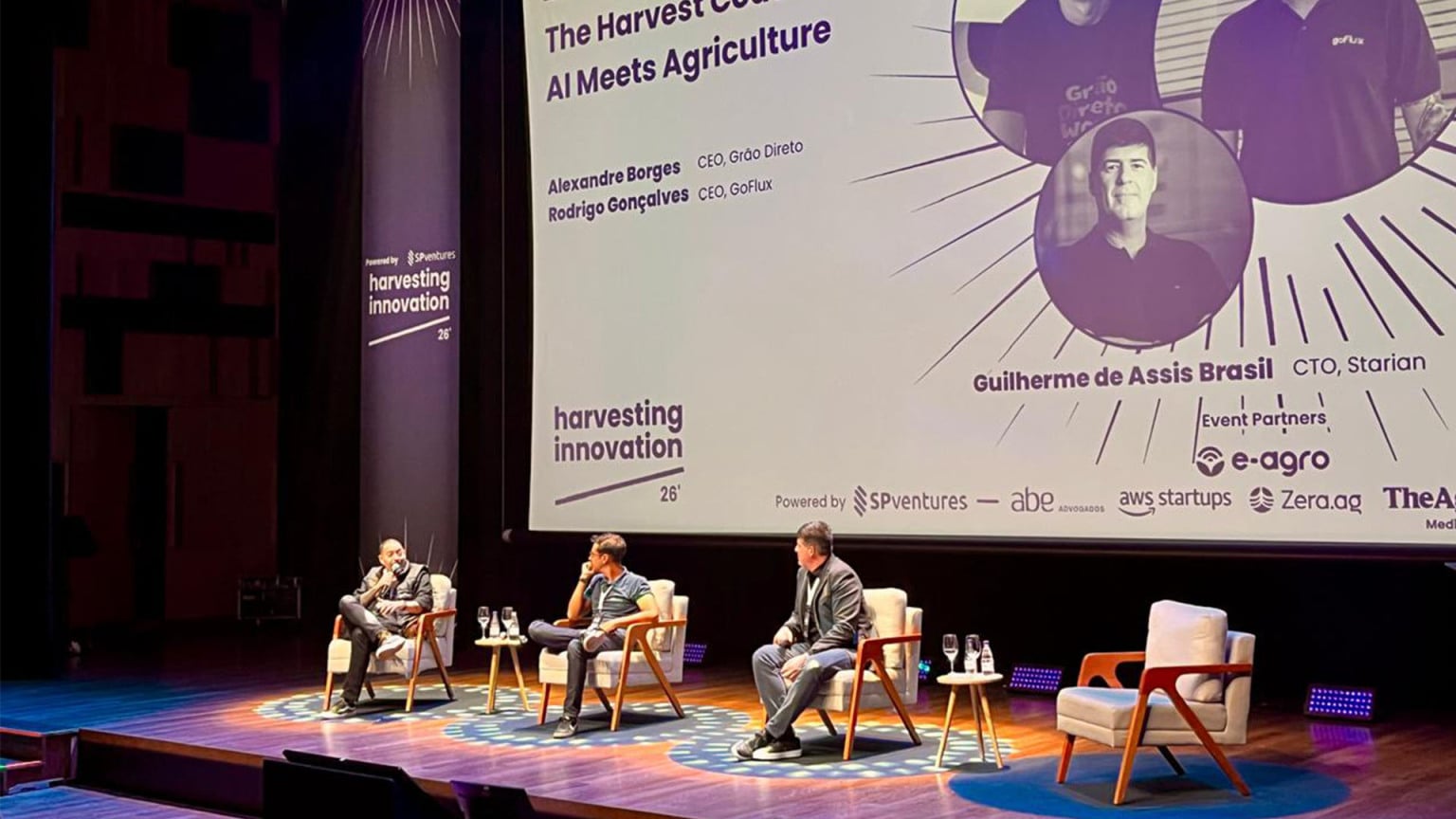

Artificial intelligence is rapidly becoming a strategic priority across agribusiness, but industry executives say the sector still faces a fundamental obstacle: a lack of high-quality, connected data.
Despite growing interest in AI-powered tools, much of the agricultural value chain continues to rely on offline processes and fragmented information, limiting the technology’s ability to generate meaningful productivity gains.
“You can’t have a serious conversation about AI if the data is still analog, disconnected and unavailable,” Alexandre Borges, CEO and co-founder of grain trading platform Grão Direto, said during Harvesting Innovation, an annual event hosted by venture capital firm SP Ventures in São Paulo.
According to Borges, the industry’s immediate challenge is less about adopting sophisticated AI models and more about building the digital infrastructure needed to support them.
“If companies don’t digitize their processes first, they won’t be able to capture value from AI,” he said.
That reality has led Grão Direto to invest in direct customer engagement to help producers and grain market firms improve data collection and operational workflows before implementing more advanced technologies.
The risk, Borges said, is that companies simply automate inefficiencies.
“Digitizing a bad process only scales mistakes,” he said. “AI creates an opportunity to redesign processes from the ground up. The objective isn’t to become a taxi cooperative with an app; it’s to become Uber.”
Data Origination Becomes a Competitive Advantage
For Rodrigo Gonçalves, founder and CEO of freight management and financing platform GoFlux, the quality and availability of operational data will increasingly determine which companies capture value from AI.
“The biggest challenge is connecting information,” Gonçalves said. “A significant amount of freight is still negotiated over the phone. If an operation happens offline, it effectively doesn’t exist from a digital standpoint and can’t be used as data for AI applications.”
The comments underscore a broader issue facing the sector: while AI models continue to improve at a rapid pace, the underlying data infrastructure across agriculture remains uneven.
As a result, companies are increasingly positioning themselves not only as software providers but also as implementation partners, helping customers digitize workflows and structure information.
“The approach we’re taking is to become a co-pilot for our clients,” Gonçalves said. “Because we understand their logistics operations in depth, we can test practical AI applications much more effectively.”
He argued that the speed of AI development is making delays increasingly costly.
“If I stop monitoring developments for two days, by the third day the models are already capable of doing something different,” Gonçalves said. “Companies that are still preparing to begin their AI journey are effectively procrastinating. Adoption is no longer optional.”
Balancing Open-Source and Proprietary AI
Executives were also asked whether agribusiness companies should rely on open-source AI models or invest in proprietary systems.
The debate has intensified following recent US restrictions on foreign access to certain Anthropic AI models, highlighting potential risks associated with dependence on third-party providers.
Both of them said the future is likely to involve a hybrid approach.
“For many use cases, it doesn’t make economic sense to build a proprietary model,” Gonçalves said. “Using existing solutions is more efficient. But where local regulations, business rules or specialized methodologies are involved, developing proprietary technology can create a competitive advantage.”
GoFlux’s logistics credit-scoring methodology is one example, he said.
Borges echoed that view, arguing that companies should distinguish between accessing cutting-edge AI capabilities and protecting strategic data assets.
“If you want access to the technological frontier, the major global players are far ahead,” he said. “But when you’re working with sensitive or proprietary information, you don’t necessarily need the most advanced model. In those cases, ownership and trust can be more important.”
That distinction is becoming increasingly relevant as agribusiness firms seek to turn proprietary datasets into defensible advantages.
Grão Direto’s own AI platform, Ayrton, illustrates the potential. The tool accounted for 20% of all transactions executed through the company’s marketplace last year, according to Borges.
For investors and agribusiness executives, the message was clear: the winners in agricultural AI may be determined less by access to algorithms than by ownership of high-quality data and the ability to integrate it across operations.
This article was translated with the assistance of artificial intelligence


